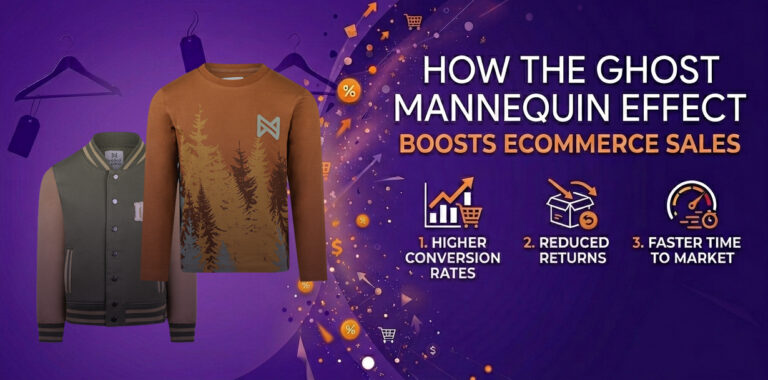
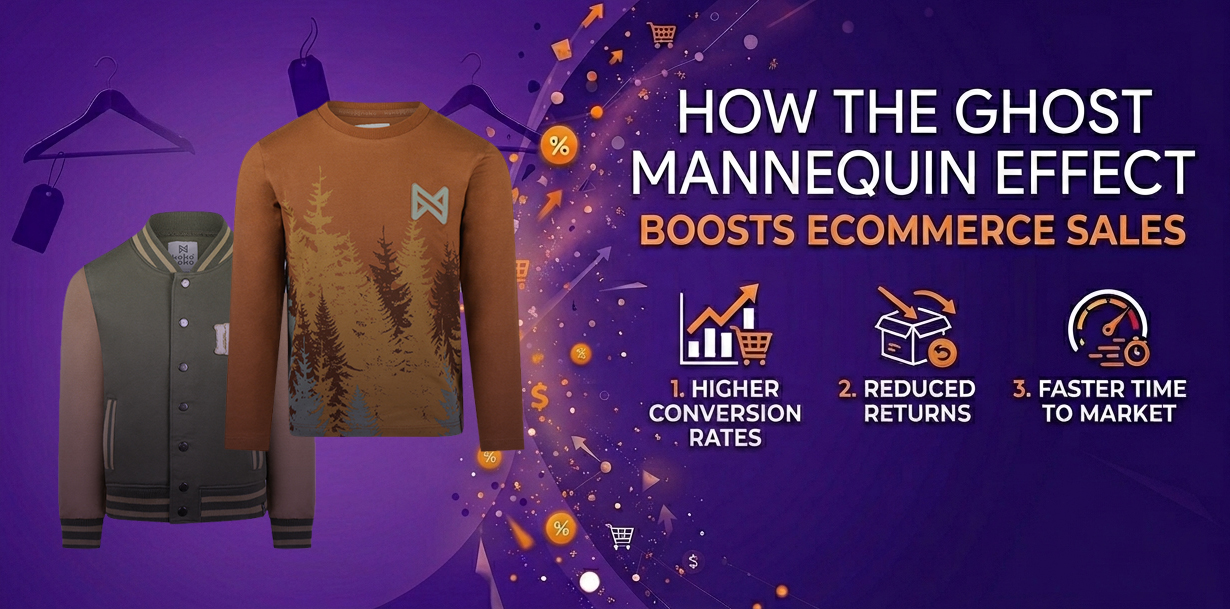
The ghost mannequin effect is a popular technique used by online clothing brands worldwide. This technique increases sales while reducing overall post-processing and maintenance costs.
What Is the Ghost Mannequin Effect?
Ghost mannequin effect is a popular product photography and post-processing method that makes clothing appear as though it is being worn by an invisible person.
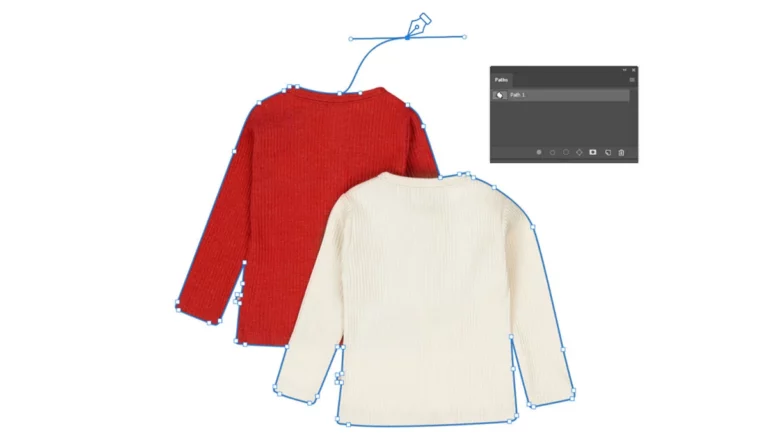
The technique involves photographing garments on a mannequin and then using photo editing software, such as Adobe Photoshop, to remove the mannequin while preserving the human body shape. The result is a clean, three-dimensional, lifelike product image in which the clothing retains its natural shape and volume.
This approach has become a go-to standard for fashion and apparel photography in eCommerce. Big brands like ASOS, Zara, and Nike use it, along with thousands of small and mid-sized clothing businesses around the world. The reason is simple—it helps present garments in a clean, structured, and attractive way without distracting the viewer with a model or mannequin.
Quick Definition: Ghost Mannequin = Photograph the garment on a mannequin → Remove the mannequin in post-production → Result: a clean, 3D floating garment that looks worn but has no visible wearer.
The Origin of the Technique
Before this, fashion brands mostly relied on model photography. But as online shopping started growing in the early 2000s, brands needed a faster and more cost-effective way to produce large volumes of product images. That’s when the ghost mannequin technique really took off. It offered the perfect balance between realism, speed, and cost. Today, many professional photo editing studios focus entirely on this method because it delivers consistent, high-quality results for online stores.
Why It Works: The Psychology of Product Presentation
Understanding why ghost mannequin photography converts so well requires a look at consumer psychology and how the human brain processes product images in an online shopping context.
Mental Simulation
Shoppers mentally “try on” items when garments appear full and 3D. A flat, lifeless image prevents this cognitive process — a ghost mannequin encourages it.
Focus on the Product
Without a model’s face, hair, or body in frame, the customer’s eye goes directly to the garment’s design, fit, cut, and texture — exactly what drives purchase intent.
Perceived Fit & Volume
A structured, 3D garment helps customers accurately gauge how a piece will fit and move. This reduces uncertainty — one of the top reasons for cart abandonment.
Professional Trust Signal
Clean, consistent ghost mannequin images communicate quality and professionalism, which directly increases brand trust and willingness to purchase.
Reduced Cognitive Load
No distracting backgrounds or people means the shopper processes the product faster and with less decision fatigue — streamlining the path to purchase.
Accurate Shape Representation
Ghost mannequin preserves the garment’s exact silhouette and structure, helping customers understand collar type, sleeve length, hemline, and overall proportions.
When a customer cannot touch or try on a product, the image has to do all the selling. Ghost mannequin photography is the closest thing to handing the garment to someone through a screen.
Ariful I Evan
Key Statistics & Impact on Ecommerce Sales
The data behind ghost mannequin photography is compelling. Across multiple studies of online fashion retailers, the technique consistently outperforms flat-lay, hanger, and even some live-model approaches in key conversion metrics.
- By the Numbers
Ghost Mannequin Effect — Ecommerce Impact Statistics
Average increase in conversion rate vs. flat-lay images
Reduction in product return rates due to better fit visualization
Higher add-to-cart rate compared to hanger photography
More time spent on product pages with ghost mannequin images
Of consumers say image quality is “very important” in purchase decisions
Lower cost per image versus hiring a live model for equivalent shots
These figures reflect consistent findings across fashion ecommerce studies. The conversion uplift alone justifies the investment for most retailers — even a 5% improvement in conversion on a mid-sized apparel store can generate tens of thousands of dollars in additional annual revenue.
Top Benefits for Online Retailers
Ghost mannequin photography offers a multi-dimensional value proposition for ecommerce businesses of every size. Here is a comprehensive breakdown of its key advantages:
- Higher conversion rates — shoppers are more confident purchasing when they can see the garment’s true shape and structure.
- Lower cart abandonment — uncertainty about fit is reduced when a product appears three-dimensional and life-like.
- Increased average order value — clear, professional imagery positions products as premium, supporting higher price points.
- Reduced return rates — accurate visual representation of fit and silhouette means fewer “it didn’t look like the picture” returns.
- Stronger repeat purchase behavior — customers who receive what they expected visually are significantly more likely to buy again.
- Clean, adaptable images that work across all sales channels — website, Amazon, Shopify, Instagram, email campaigns, print catalogs.
- Easy to create A/B test variations without re-shooting (color, background, angle adjustments in post).
Ghost Mannequin vs. Other Photography Methods
Not all product photography approaches are created equal. Here is how ghost mannequin stacks up against the main alternatives used in fashion ecommerce today:
| Factor | Ghost Mannequin | Live Model | Flat Lay | Hanger Shot |
|---|---|---|---|---|
| 3D Shape Representation | ✔ Excellent | ✔ Excellent | ✘ Poor | ✘ Poor |
| Cost Per Image | ✔ Low–Medium | ✘ High | ✔ Very Low | ✔ Very Low |
| Consistency at Scale | ✔ High | ✘ Medium | ✔ High | ✔ High |
| Conversion Rate Impact | ✔ Very High | ✔ High | ⚡ Medium | ✘ Low |
| Return Rate Reduction | ✔ Strong | ✔ Strong | ✘ Weak | ✘ Weak |
| Production Speed | ✔ Fast | ✘ Slow | ✔ Very Fast | ✔ Very Fast |
| Brand Lifestyle Feel | ⚡ Neutral | ✔ High | ✔ Stylistic | ✘ Low |
| Best For | Catalog / PDP pages | Hero / Campaign | Social / Editorial | Quick internal use |
Note: ✔ = Strength, ✘ = Weakness, ⚡ = Neutral/Contextual
The table makes clear that ghost mannequin occupies a unique sweet spot: it delivers the visual impact of live model photography at a fraction of the cost, with higher scalability and consistency. For catalog-scale operations — hundreds or thousands of SKUs — it is virtually unmatched.
Industries & Apparel Categories That Benefit Most
While ghost mannequin photography is broadly useful across apparel, certain garment categories see outsized benefits due to the importance of structure and fit communication.
Formalwear sees an average conversion uplift of 41%, while dresses follow closely with a 38% increase. Outerwear performs even better with a 45% uplift, and casualwear or tees achieve around 29%. Swimwear and lingerie show a solid 33% improvement, while sportswear contributes a 31% average conversion uplift.
Structured garments like blazers, coats, structured dresses, and knitwear benefit the most — these are categories where the three-dimensional shape is critical to the customer’s purchase decision. Soft, drapey fabrics like silk or chiffon also benefit greatly because ghost mannequin photography captures their natural drape and flow far better than flat-lay photography.
Conversion & Sales Impact — Visual Data
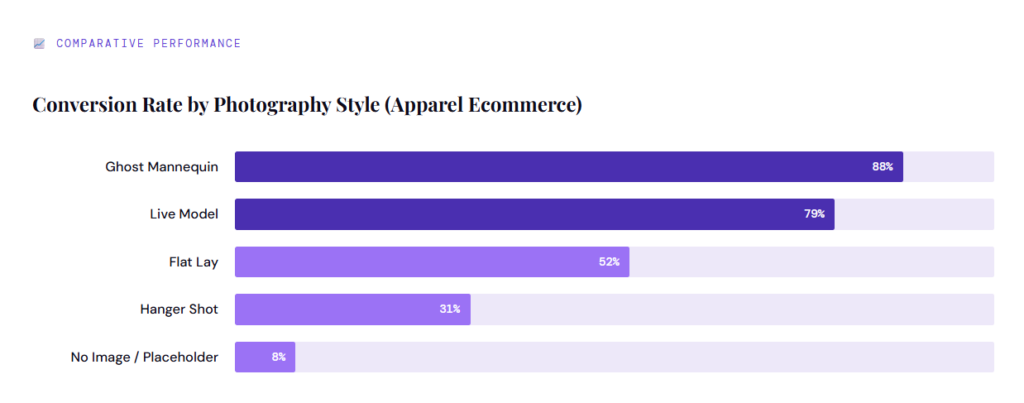
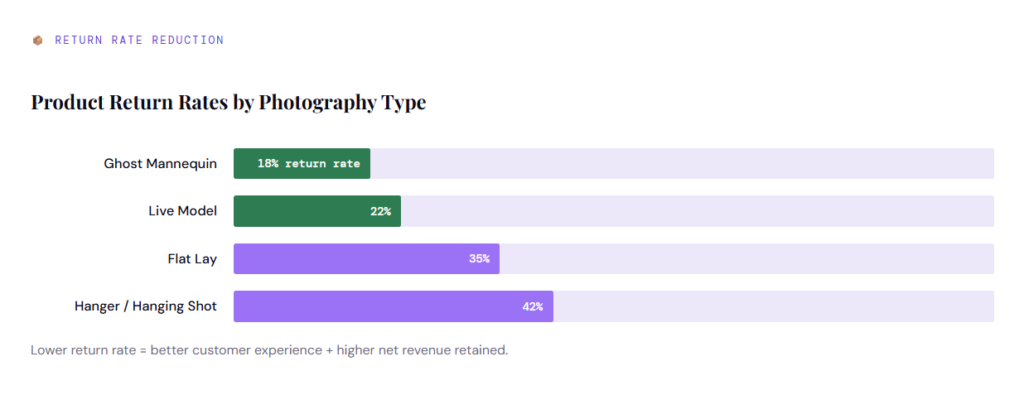
These charts illustrate how photography style directly impacts both conversion rates and product return rates in apparel eCommerce. While high-quality, well-executed visuals can significantly boost conversions by attracting and convincing customers, they also play a crucial role in setting accurate expectations—helping reduce return rates by ensuring products look true to life across different photography types.
ROI & Cost Considerations
One of the strongest arguments for ghost mannequin photography is its compelling return on investment. Let’s break down the numbers with a realistic scenario for a mid-size apparel brand:
📌 Example Scenario: An online apparel store launches 200 new SKUs per season. Current photography uses flat-lay, with a 2.1% conversion rate and 31% return rate.
| Metric | Flat-Lay (Current) | Ghost Mannequin (New) | Difference |
|---|---|---|---|
| Photography cost (200 SKUs) | $800 | $1,400 | +$600 |
| Editing/retouching cost | $200 | $600 | +$400 |
| Conversion rate | 2.1% | 2.87% (+36%) | +0.77% |
| Monthly revenue (50k visitors, $65 AOV) | $68,250 | $93,275 | +$25,025 |
| Return rate | 31% | 18.6% (-40%) | -$7,700 saved |
| Net monthly gain | — | — | ~$31,725 |
The additional photography and editing investment of $1,000 per season yields approximately $31,000+ in monthly net revenue improvement — a return multiple that makes ghost mannequin photography one of the highest-ROI investments available to an ecommerce apparel business.
Pricing Guide: Ghost Mannequin Services
- DIY (in-house):$1.00–$5.00 per image if you have trained staff and equipment. Initial setup cost of $2,000–$8,000 for studio gear and mannequins.
- Freelance retoucher:$1–$5 per image. Quality varies significantly. Best for small volumes under 100 images per month.
- Specialist retouching studio (offshore):$1.50–$3 per image. Consistent quality, high volume capacity. Ideal for 500+ images per month.
- Full-service photography studio (shoot + editing):$15–$40 per image all-in. Best quality control but highest cost. Ideal for hero products and seasonal launches.
Conclusion: A Non-Negotiable Investment for Fashion Ecommerce
The ghost mannequin effect is not a luxury or a nice-to-have in modern fashion ecommerce — it is a foundational pillar of a high-converting product catalog. The evidence is overwhelming: it consistently outperforms alternative photography methods in conversion rate, return rate reduction, time-on-page, and brand trust across virtually every apparel category.
As online competition in fashion intensifies and customers increasingly expect high-quality visual experiences, the brands that invest in professional ghost mannequin photography will hold a measurable advantage over those that do not. Whether you implement this in-house or work with specialist studios, the ROI calculations are clear: every dollar spent on quality product imagery returns many times over in increased sales and reduced operational friction.
In ecommerce, your product images are your storefront window, your fitting room, and your sales associate all rolled into one. Ghost mannequin photography makes each of those jobs far more effective.
If you have been relying on flat-lay, hanger shots, or inconsistent photography across your catalog, a migration to consistent ghost mannequin imagery is likely the single highest-impact change you can make to your ecommerce conversion funnel today.
Start with your top 20% of best-selling SKUs, measure the impact on conversion and returns over 60 days, and let the data guide your full catalog migration. The results will speak for themselves.